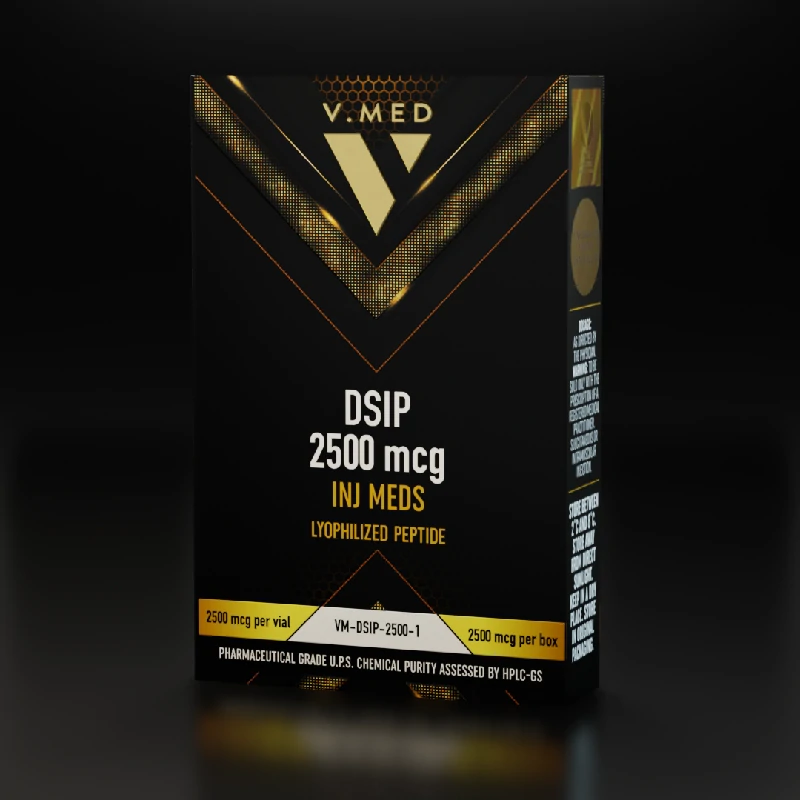
EPITALON 140 mg
Epitalon is a synthetic tetrapeptide, Ala-Glu-Asp-Gly, derived from the pineal peptide epithalamin and is primarily researched for its geroprotective, circadian, and telomere related effects. It is commonly used in longevity and recovery focused settings where melatonin regulation, cellular ageing pathways, and restorative support are prioritised. Epitalon is valued for its regulatory and restorative profile rather than anabolic, hormonal, or performance driven outcomes.
Epitalon is a synthetic tetrapeptide studied mainly in ageing, pineal regulation, and telomere biology research. It is commonly associated with melatonin rhythm support, cellular ageing regulation, and broader restorative processes rather than direct muscle building or endocrine manipulation. Current interest in Epitalon is driven mostly by cell studies, animal work, and a limited body of older human literature.
Properties and Effects
Supports telomerase related activity and telomere maintenance research
May support circadian rhythm and melatonin related regulation
May support antioxidant and restorative ageing pathways
May support neuroregulatory and tissue maintenance processes
Does not act through anabolic pathways linked to testosterone or oestrogen control.
Mechanism of Action
Epitalon is primarily discussed as a regulatory short peptide rather than a receptor driven performance compound. In human somatic cells, it has been reported to induce expression of the catalytic subunit of telomerase, increase telomerase activity, and promote telomere elongation. Recent cell line work also supports telomere length effects through telomerase upregulation or alternative lengthening pathways, but that remains preclinical rather than clinical proof.
Recommended Use
Epitalon is typically used in longevity, recovery, circadian support, or restorative protocols. It is generally considered during periods where sleep rhythm, ageing related decline, or broader recovery support are being prioritised rather than physique enhancement. A more precise thesis framing is that Epitalon is an investigational longevity oriented peptide, not a clinically established anti ageing treatment.
Safety and Side Effects
The safety profile appears relatively favourable in the limited available literature, but the evidence base is not strong by modern standards. The ADDF review states that limited evidence suggests epithalamin is likely safe for long term use, while also noting the lack of strong human evidence and the absence of direct cognition prevention trials. It does not suppress natural testosterone and does not aromatise because it is not an anabolic or androgenic agent.
Special Notes
Epitalon is not a steroid, growth hormone, SARM, or SERM. It is better classified as a short regulatory peptide studied for geroprotective, pineal, circadian, and telomere related effects. The main weakness in the literature is not the absence of mechanistic signals, but the gap between those signals and robust modern clinical confirmation in humans.
Recommended dosage
There is no universally accepted approved human dosing standard. Older schedules summarised by the ADDF review include intramuscular use at 5 to 10 mg daily for 10 to 20 days and intranasal use at 10 to 30 mg daily for 20 to 30 days. For a140 mg, that would roughly equal 14 days at 10 mg daily or 28 days at 5 mg daily, depending on the protocol being mirrored.
Timing of doses
Timing in the literature depends on the protocol rather than one universal rule. Most schedules are daily for a defined block of days, often followed by a break before another course. Because Epitalon is often discussed in relation to circadian and pineal regulation, some protocols place it earlier in the day, but there is no clear single gold standard timing model in the literature.
Practical guidance
Epitalon is usually approached as a cycle based restorative peptide rather than a continuous daily product. Consistency across a defined course matters more than exact hour of administration. For thesis accuracy, it is better to present Epitalon as a peptide with promising mechanistic and preclinical data plus limited human evidence, not as a proven longevity intervention.
Estimated Degradation
Model classification
Moderate stability, possibly moderate to relatively stable in lyophilised form, with lower stability once reconstituted into solution. This is an inference from general peptide storage guidance rather than a validated potency curve for a commercial Epitalon vial.
Evidence strength
Weak for exact post reconstitution vial stability, moderate for general peptide stability reasoning. I did not find a strong primary source establishing a validated week by week potency curve for mixed Epitalon.
Assumption used
Reconstituted with bacteriostatic water and stored refrigerated at 2 to 8 degrees Celsius, protected from light, with minimal agitation. The degradation model below is a conservative educational estimate based on standard peptide handling logic rather than direct assay data for your specific vial.
Estimated degradation model for EPITALON 140 mg
| Time after mixing | Estimated remaining potency | Estimated degradation |
|---|---|---|
| 1 week | 94% | 6% |
| 2 weeks | 87% | 13% |
| 3 weeks | 79% | 21% |
| 4 weeks | 70% | 30% |
| 5 weeks | 60% | 40% |
| 6 weeks | 50% | 50% |
Additional Product Information
| Product Name | EPITALON 140 mg |
|---|---|
| Also Known As | Synthetic Tetrapeptide |
| Product Stock Code | VM-EPITALON-140-1 |
| Categories |  Peptides / Growth Hormones Peptides / Growth Hormones |
| Contents | Ala-Glu-Asp-Gly, Synthetic Tetrapeptide |
| Presentation Size | 140 mg per vial |
| Strength | 140 mg per box |
| Product Container | Peptides |
More Information
Please login to view more